Publication
15. Origin and early diversification of a high Andean rove-beetle clade: Corisantis gen. nov., phylogeny, and historical biogeography
Authors: Chani-Posse, M. & Rodríguez-Melgarejo, M.
Journal: Zoologischer Anzeiger, 313, 395–416.
Date:
Highlights
Abstract
Introduction
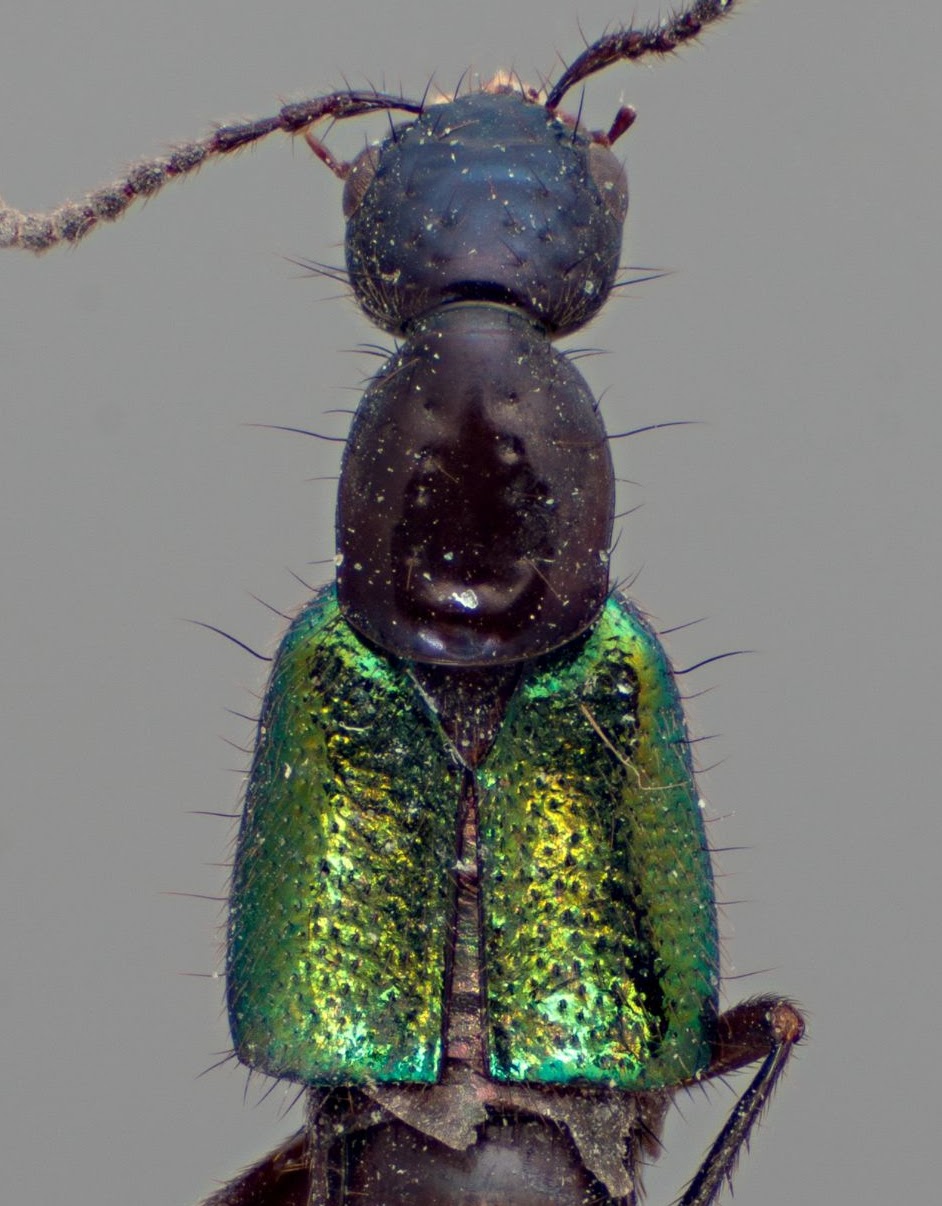
A new genus, Corisantis gen. nov., within the Andean clade (AC) of the rove-beetle subtribe Philonthina, is described and illustrated, including 14 species.
Material & Methods
This study provides diagnoses, redescriptions or descriptions, illustrations, a distribution map, and an identification key for the species of Corisantis.
Results
This new genus comprises six valid species formerly assigned to Belonuchus Nordmann (B. candens (Erichson, 1840) and B. pulchripennis Bernhauer, 1908) and Philonthus (Ph. auripennis Bernhauer, 1916; Ph. caliensis Bernhauer, 1916; Ph. excellens Bernhauer, 1916; and Ph. whymperi Sharp, 1891), along with nine newly described species: C. ancashensis sp. nov., C. bongarensis sp. nov., C. cajamarcanus sp. nov., C. columbiensis sp. nov., C. ecuatoriensis sp. nov., C. grandis sp. nov., C. levis sp. nov., C. magdalensis sp. nov., and C. napoensis sp. nov. The four species originally classified under Philonthus are reassigned to Corisantis with the following new combinations: C. auripennis (Bernhauer, 1916) comb. nov., C. caliensis (Bernhauer, 1916) comb. nov., C. excellens (Bernhauer, 1916) comb. nov., and C. whymperi (Sharp, 1891) comb. nov. Additionally, Belonuchus pulchripennis is synonymized under Belonuchus candens (=B. pulchripennis syn. nov.), which is also transferred to Corisantis as C. candens (Erichson, 1840) comb. nov. Lectotypes are designated for B. pulchripennis Bernhauer (1908), Philonthus candens Erichson (1840) and Philonthus whymperi Sharp (1891). Phylogenetic analyses, employing three methodologies—Maximum Parsimony, Maximum Likelihood, and Bayesian Inference—consistently support the monophyly of Corisantis and confirm its sister-group relationship with Leptopeltoides Chani-Posse and Asenjo, with both genera being sister to Leptopeltus Bernhauer. Additionally, biogeographical analyses using two methodologies—BBM (Bayesian Binary MCMC) and S-DIVA (Statistical Dispersal-Vicariance Analysis)—suggest that the South American Transition Zone was the center of origin and early diversification for these three genera.